
Your potential customers are now asking ChatGPT, Perplexity, Gemini, and other AI platforms to compare companies & tools, explain complex topics, recommend service providers, and help them make buying decisions. In many cases, they get a complete answer without visiting Google or clicking a single search result.
It is no longer enough to rank well. Your company also needs to become part of the answer. AI systems must understand what your brand does, trust your expertise, find clear evidence to support your claims, and consider your content useful enough to cite or recommend.
In this playbook, I will break down how AI search engines find information, why some brands appear repeatedly in generated answers, and what you can do to increase your visibility across ChatGPT, Google AI Overviews, Perplexity, Gemini, and other AI-driven search experiences.
A Simple Definition of AI SEO (GEO or AEO)
AI SEO, GEO, AEO, and LLM SEO are all ways of talking about helping your business show up when people ask AI tools for answers. In simple terms, you make it easier for tools like ChatGPT, Gemini, and Google’s AI to find and understand your business, and mention it when it’s relevant.
For example, if someone asks ChatGPT, “What are the best project management tools for a small team?” AI SEO can help your product appear in the answer.
Traditional SEO, on the other hand, focuses mainly on helping your website rank in search results, like Google’s blue links. AI SEO focuses on helping your business get included in AI-generated answers. However, there’s a lot of overlap: both rely on useful content and a website search engines can understand.
What the Winning AI Search Strategy Looks Like in 2027?
In my opinion, businesses should care less about rankings and organic traffic on their own, and more about whether their brand appears when people ask AI for the best tools, software, services, or products, and when they compare their options.
SEO has changed a lot over the last year or two. Useful content and a technically sound website still matter, but they’re only part of the picture. Brands also need to build a strong reputation: earn genuine reviews, keep their business information clear and consistent, and appear in the places where people research and compare options.
In other words, AI SEO is about the overall presence of your brand, not just publishing more blog posts, adding internal links, or creating service pages at scale. IMO, today the question is: when someone is deciding what to buy, does your brand appear in the conversation?
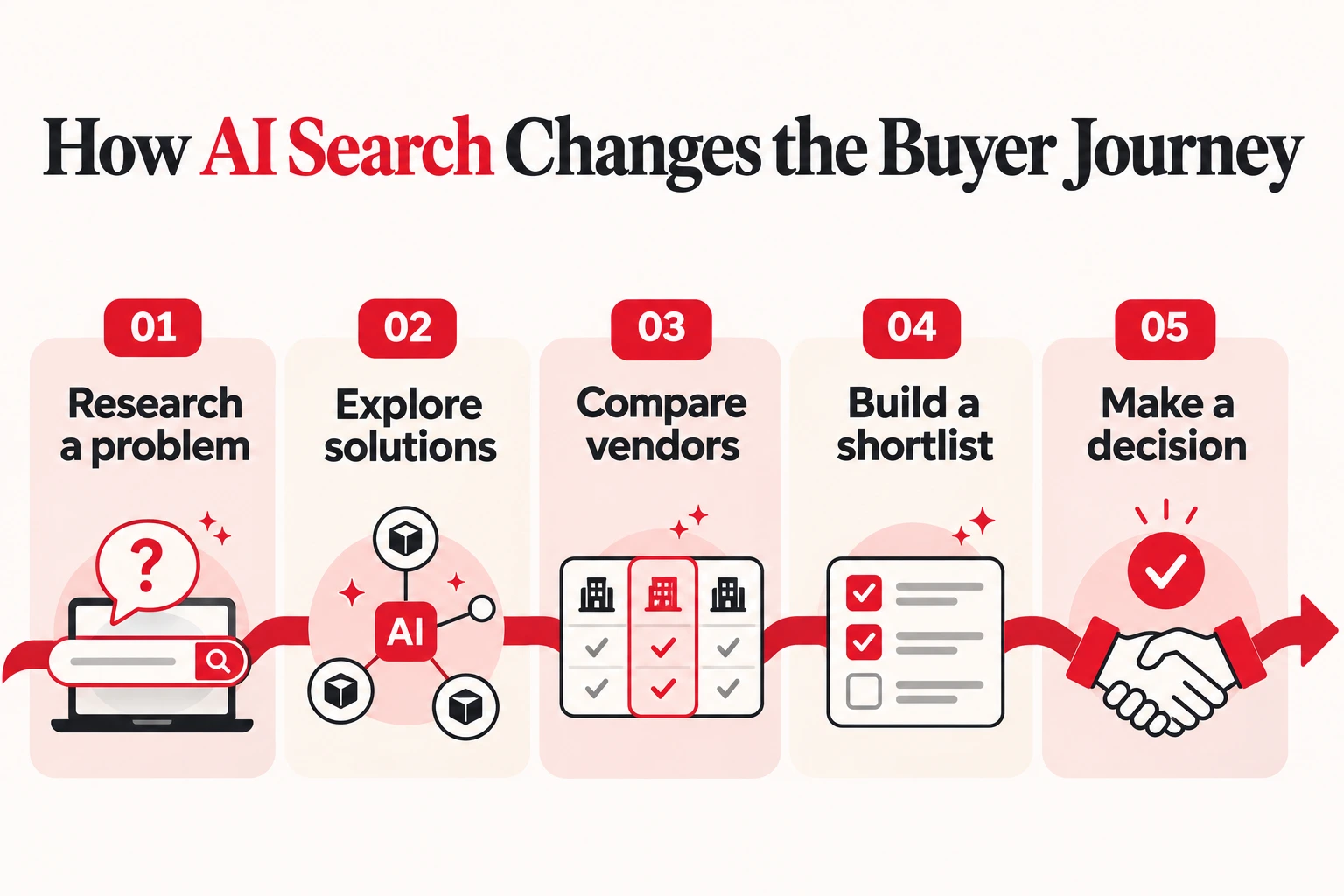
How AI Search Changes the Buyer Journey
AI has changed how people research what to buy. Instead of opening lots of websites and comparing everything themselves, they can ask ChatGPT or Gemini for recommendations, pros and cons, and a shortlist of options.
It means people may hear about your brand before they ever visit your website. They might ask AI which tools are best, compare a few options, and arrive at your site already knowing what they want.
So being easy to find is still very important, but it’s also essential for your brand to be clear, trusted, and mentioned in the places AI uses to shape its answers.
The Benefits of AI SEO (LLM SEO/GEO/AEO)
Search Is Moving from Links to Synthesized Answers
Search used to be simple. A user typed a query into Google, and the platform served up ten blue links. Sadly, that utility model is dead. Today, tools like Perplexity and Google’s Gemini read hundreds of sources in milliseconds to compile a single, direct answer. ChatGPT processes 2.5 billion prompts daily.
The searcher gets what they need right on the screen in a single synthesized answer, without clicking. If your content gets pulled into that answer, you win visibility without needing a #1 ranking. If it doesn’t, you’re invisible, even if you rank well organically.
Ranking No Longer Guarantees the Click
Zero-click searches hit 69% in 2025. That means roughly seven out of ten Google searches end without anyone clicking a single result. Holding position one on Google used to feel like printing money. Not anymore, because now Google AI Overviews swallow the top half of the screen on almost every commercial query.
The user reads the summary, finds their answer, and closes the tab. I know what you’re thinking- it’s brutal out there.
When we run AI SEO audits for clients, we consistently see top-ranking URLs losing half their organic traffic overnight. Securing dedicated SEO for AI Overviews is how you survive this shift. You have to win placement directly inside the generative snippet, or accept that your top rank is purely cosmetic.
AI Systems May Use Different Sources from Organic Results
Here’s something that shocks most marketing directors. A page ranking number one on Google often gets completely ignored by ChatGPT or Claude. Read that again. Generative models train on distinct data lakes. They favor sentiment on Reddit, discussions on Quora, and verified reviews on G2 over traditional backlink profiles.
If your entire strategy relies on traditional keyword optimization on your own blog, the models won’t cite you. You need a presence across the places where these neural networks validate truth. Winning citations requires building authority across the broader web, not just polishing your own domain.
AI Search Changes the Customer Journey
The traditional buyer journey was a long, slow grind. A prospect searched ten different terms, opened twenty tabs, and compared tools over three weeks. Generative AI trends have changed that entirely. Now, a buyer asks ChatGPT: “Compare HubSpot and ActiveCampaign for a 50-person team.”
The model spits out a detailed comparison with pros, cons, and pricing in three seconds. Done. The entire evaluation phase happens inside a single prompt box.
If your product isn’t recommended in that initial answer, you never even get a chance to pitch.
You are erased from the consideration set before the user visits a single website. The traffic is smaller, but the intent is dramatically higher. They arrive pre-informed and pre-qualified because the AI already did the research phase for them.
Brand Visibility Is Becoming a Search KPI
Measuring campaign performance purely by web clicks is an outdated habit. Here’s the thing. When an LLM names your software as the top solution in your niche, thousands of decision-makers see it. Most won’t click through immediately- they don’t need to. But when it comes time to buy, your brand is already the industry standard. That trust is massive.
At NEWMEDIA.COM, we treat AI share of voice as a primary performance metric. Partnering with a specialized AI SEO agency ensures your brand gets recommended where it matters most: inside the model’s primary memory.
Top 8 AI SEO & GEO Strategies for 2027
We’ve tested a lot of approaches over the last couple of years, and it seems like there’s a big overlap between traditional SEO and GEO. However, if you want your brand to appear in platforms like ChatGPT and Gemini, there are a few things worth paying extra attention to.
Here are eight GEO strategies we’ve tried and tested to help your brand appear in AI recommendations, and generate more referral traffic, leads, and revenue from AI-powered search.
Build the Technical Foundation for AI SEO
Before worrying about citations and brand mentions, make sure your site is technically sound. Most audits miss the biggest issue: JavaScript rendering. However, crawlers like GPTBot and PerplexityBot are incredibly lightweight. If they hit heavy JavaScript, they skip your content completely. You get no second chances.
You need a pristine technical foundation. Start by auditing your robots.txt file. Make a deliberate choice to allow retrieval bots (like OAI-SearchBot) that drive citation traffic.
Many of our clients accidentally block AI search entirely because they panicked over data scraping. Serve your content via server-side rendering so the raw HTML is immediately readable. Speed dictates visibility. If the model can’t parse your site in milliseconds, you won’t make the answer pool.
Get Included in the Conversations That Shape Shortlists
When people ask AI which products or services to consider, the answer often draws on sources such as comparison pages, industry directories, Reddit discussions, publications, and review platforms. Find out which of these sources appear in AI answers for the questions your buyers ask.
A useful way to do this is to run the same commercial prompts across major AI platforms, for example, “What are the best tools for managing a remote team?”, and record which brands and sources are cited.
Over time, you’ll start to see which sources keep appearing. If they’re relevant to your business, look for legitimate ways to earn a place there, such as contributing expert insight or submitting your company for an accurate listing.
These credible mentions can give AI more reliable information about your brand and help strengthen the case for including it in answers. Track the citations over time to see whether your visibility changes. Focus on earned placements and accurate information; never spam or fake reviews.
Use Structured Data Correctly
Schema markup is no longer just for fancy search snippets. It is the native language of generative search. If you want a model to cite your product pricing or feature list, you must feed it structured data.
Organization schema, FAQ schema, Article schema, Author schema, and Product schema are the ones that matter most for AI SEO.
AI engines are confident, but they are also lazy. They pull the easiest, cleanest data available. If a competitor hands them perfectly validated JSON-LD and you hand them a messy paragraph, the competitor wins the citation. You need to serve the data directly.
Strengthen Entity Consistency
As I mentioned earlier, brand search volume is the strongest predictor of AI citations. But volume alone isn’t enough. AI models also cross-reference how consistently your brand is described across the web.
If your LinkedIn says you’re a “digital marketing agency,” your website says “growth consultancy,” and G2 says “SEO platform,” the models lose confidence and recommend a competitor with cleaner signals.
Audit every place your brand appears online and standardize three things: your category, the problem you solve, and the audience you serve. Your website, Google Business Profile, social profiles, directories, and review platforms should all match. Clean signals earn citations, while conflicting ones get you skipped.
Build Authority Beyond Your Website
Your own website is only one input in how AI models decide who to cite. ChatGPT pulls heavily from Reddit, Wikipedia, and licensed publishers. Perplexity favors real-time forum content. Google AI Overviews pull from a broader mix but still weight third-party mentions.
That means your off-site presence matters as much as your on-site content. If you want to be cited as the best AI for PPC management tool, people need to talk about you elsewhere. Get featured in industry publications, earn mentions in “best of” listicles, contribute expert quotes to relevant articles, and publish on platforms AI models trust, rather than just your own blog.
Distributing content to external publications can increase AI citations by up to 325% compared to publishing only on your own site.
Build Expert and Author Entities
AI models evaluate websites and also the people behind them. Google’s E-E-A-T framework and LLM citation patterns both favor content tied to recognized experts with verifiable credentials. If your content has no author, or the author has no presence outside your site, you’re at a disadvantage.
Build author pages on your website with real bios, credentials, and links to external profiles. Make sure your experts are publishing on LinkedIn, contributing to industry publications, and appearing on podcasts.
The more places an AI model can verify that this person is a credible source on this topic, the more likely your content is to get cited. If you want to rank among the top AI SEO agencies, make your experts visible and verifiable across the web.
Improve Review and Reputation Signals
AI search engines love reviews. They pull user sentiment directly from sites like G2, Capterra, Trustpilot, and Google Reviews to evaluate products. If your G2 rating sits at 3.2 stars, ChatGPT will tell buyers to look elsewhere.
You need a systematic strategy for generating reviews. Ask happy clients for detailed feedback. Monitor sentiment closely. Address negative complaints directly on the platform.
When a model summarizes your brand for a prospective buyer, it relies heavily on aggregate review scores. High ratings equal frequent recommendations, whereas bad reviews kill your pipeline.
Participate in Relevant Communities
Reddit and Quora are goldmines for language models. This one surprises most SEO teams, but the data backs it up. Reddit, Quora, and niche industry forums account for a significant share of AI citations- Reddit alone makes up roughly 21% of ChatGPT’s citation sources. Perplexity draws more heavily from Reddit.
That means genuine participation in communities where your ICP hangs out directly impacts your AI search visibility. Genuinely answering questions, sharing expertise, and being helpful in conversations where your category comes up. If your brand is naturally woven into those discussions, you win implicit citations.
Over time, your brand name and your experts’ names start appearing in the threads AI models pull from when generating answers. It’s slow, unglamorous work, but it’s one of the most underrated AI SEO strategies available right now.
Optimize for Each Major AI Platform Without Creating Separate Strategies
A lot of clients expect ChatGPT, Gemini, and other AI platforms to need completely different SEO strategies. However, it’s simpler than that. They rely on many of the same signals when choosing what to mention or cite, so the core principles overlap.
There are still a few platform-specific details worth knowing.
What KPIs Should You Track for AI and GEO Visibility?
We’re testing dozens of tools to track how brands appear in AI answers, but none gives a complete, perfectly accurate picture yet. AI answers can change from one run to the next, and tools may use different prompts and methods, so track visibility scores as useful signals, not exact numbers.
Of course, measurement is improving. OpenAI has started letting eligible businesses claim their information in ChatGPT and view aggregated insights, including mentions and website clicks. Google Search Console also has reports for visibility in AI Overviews and AI Mode.
These are promising steps, and we expect AI search measurement to get more useful over time.
For now, track a mix of AI visibility, website visits, and business results. Use the same buyer-focused prompts regularly, across the same platforms, so you can spot changes over time.
How to Structure Content for AI Answers
Generative models don’t skim articles the way human readers do. They parse vector embeddings looking for direct, unambiguous facts. If your formatting is a wall of vague text, the machine skips right over you, and you lose the citation.
Structuring content for language models requires an inverted pyramid approach. Put the direct answer first, then provide the supporting detail.
Provide Answer Immediately: Don’t build up to it. State the answer, then explain it. AI models extract the clearest, most direct statement, not the one buried three paragraphs in.
Lead with Bottom Line Up Front (BLUF): Place a crisp, two-sentence definition immediately under your H2 or H3 heading. Perplexity and Google AI Overviews love pulling these concise blocks into their top summary cards. No fluff.
Use Question-Based Headings: Match your H2s and H3s directly to the natural language prompts users type into ChatGPT. Instead of “PPC Cost Factors,” write “How Much Does PPC Cost in 2026?” We saw a 35% lift in AI citations across our client accounts just by rewording subheadings into explicit questions.
Itemize Key Data with Bullet Points: Machine learning models favor clean, structured lists over dense paragraphs. Use bolded lead-ins for every bullet item to make entity extraction effortless for the parser.
Incorporate Concise Comparison Tables: When comparing tools, such as HubSpot and ActiveCampaign, use simple HTML or Markdown tables with short, punchy data cells. Tables give LLMs high-density facts without forcing them to infer context from prose.
Write Standalone Declarative Statements: Avoid weak transitional phrasing like “As mentioned above” or “In the previous section.” Generative engines extract text in isolated snippets. Every bullet point and paragraph must make complete sense when read entirely out of context.
Needless to say, none of this means you should write content that reads as if a robot wrote it for a robot. The best-performing content for AI citations is still well-written, genuinely useful, and built for human readers first. The structural tweaks above ensure AI models can find and extract the value you’ve already created.
How Do AI Search Engines Choose Which Sources to Cite?
AI search engines choose sources based on domain authority, brand search volume, entity consistency, third-party mentions, and content structure. Brand search volume is the strongest predictor of AI citations, with a 0.334 correlation, stronger than backlinks alone. Each platform pulls differently: ChatGPT relies heavily on Wikipedia, Reddit, and licensed publishers.
Perplexity favors real-time sources and forum content. Google AI Overviews pulls from its own index but place heavy weight on answer-ready content. Only 11% of domains are cited by both ChatGPT and Perplexity, so optimizing for one platform doesn’t guarantee visibility on the other.
Can You Optimize a Website to Appear in ChatGPT Answers?
First, ensure your site is indexed in Bing. (I say Bing because ChatGPT relies on it for live retrieval.) Second, check your robots.txt file. If you block OAI-SearchBot, you are completely invisible.
Next, strengthen your brand’s entity signals: make sure your category, description, and positioning are consistent across your website, LinkedIn, G2, Wikipedia, and industry directories.
Publish content that directly answers specific questions in your category with clear, extractable statements in the first few sentences. Earn mentions on third-party sites ChatGPT trusts, particularly Reddit, Wikipedia, and licensed publications. Build author entities with verifiable credentials.
How Can a Website Appear in AI Overviews?
Google AI Overviews pull primarily from pages already ranking in the top 10. 93.67% of AI Overview citations overlap with top-ten organic results. So traditional SEO fundamentals still matter here.
Beyond rankings, structure your content with clear headings that match common questions, direct answers in the first sentence of each section, and structured data where appropriate.
Blog content is the most cited page type in AI Overviews. Pages with specific data points, lists, and comparison tables get pulled more frequently than general ones.
Are Backlinks Important for AI Search Visibility?
Yes, but not the way they used to be. Language models don’t care about raw link volume. They care about entity consensus. When a model trains, it looks for your brand mentioned alongside industry terms on high-trust domains.
A mention on Reddit or a high rating on G2 carries massive weight, even without a clickable link.
Backlinks still matter, but building brand awareness through PR, podcast appearances, community participation, and executive thought leadership now contributes to AI visibility just as directly.
What Are the Best AI SEO Tools?
The best AI SEO tools fall into two categories. For tracking AI visibility and citations: Otterly, Profound, and Superlines monitor how your brand appears across ChatGPT, Perplexity, Gemini, and Google AI Overviews- something traditional tools like Google Search Console and Semrush don’t cover.
For AI-assisted SEO execution: Semrush, Ahrefs, and Surfer SEO have all added AI features for keyword clustering, content optimization, and competitor analysis. For content production: Claude, ChatGPT, and Jasper help with drafts, outlines, and meta descriptions, but bear in mind that AI-dependent content gets penalized. The human layer still matters.


